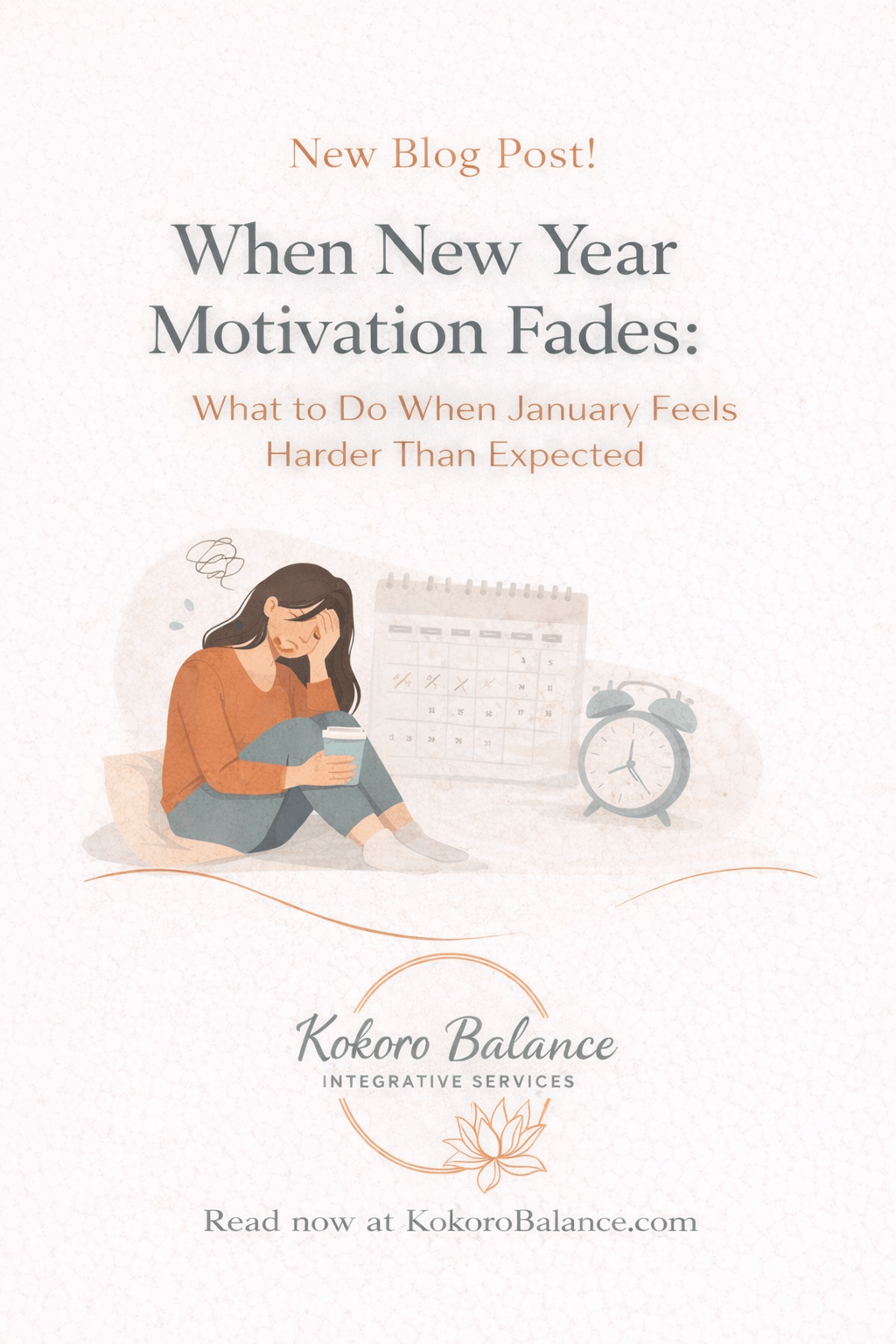
The start of a new year is often framed as a time of renewed energy, clarity, and motivation. Yet for many people, by mid-January, that momentum has quietly faded. Instead of feeling inspired, individuals may notice low energy, difficulty focusing, increased anxiety, or a sense of disappointment in themselves.
If this resonates, it’s important to know: this experience is common, understandable, and not a personal failure.
Why Motivation Often Drops in Mid-January
Motivation is not a constant internal resource, is shaped by biology, environment, emotional state, and stress levels. Research in psychology shows that sustained motivation requires more than intention or willpower; it depends on emotional regulation, recovery, and realistic expectations (Ryan & Deci, 2000).
January often arrives after months of cumulative stress:
- End of year work demands
- Financial strain
- Holiday disruptions to routine
- Emotional labor and social obligations
While the calendar changes, the nervous system does not instantly reset. Chronic stress can persist well into the new year, making it difficult to access motivation or optimism (McEwen & Gianaros, 2011).
The Role of Burnout and Emotional Fatigue
Burnout does not resolve simply because the holidays have ended. Research defines burnout as a state of emotional exhaustion, cynicism, and reduced sense of efficacy that develops over time, particularly in response to prolonged stress (Maslach & Leiter, 2016).
For many individuals, January represents a return to responsibility without sufficient recovery. When rest has been limited or incomplete, the brain prioritizes conservation of energy over goal pursuit often experienced as low motivation, avoidance, or mental fog.
This is not laziness. It is a protective response.
The Pressure of “Starting Strong”
Cultural narratives around the new year often emphasize productivity, self-improvement, and transformation. While these messages are well-intended, they can unintentionally increase self-criticism when motivation does not align with expectations.
Research on self-compassion demonstrates that harsh self-judgment in response to perceived failure is associated with increased anxiety and depressive symptoms, whereas self-compassion supports resilience and emotional well-being (Neff, 2003).
When motivation fades, many people respond by pushing harder, yet studies show that excessive pressure can further deplete psychological resources and worsen emotional distress (Baumeister et al., 2007).
Listening to What Low Motivation Is Communicating
Rather than viewing low motivation as something to fix, it can be helpful to approach it as information. Low motivation may signal:
- Unresolved stress or burnout
- Emotional overwhelm
- Need for rest or recalibration
- Misalignment between goals and current capacity
From a mental health perspective, honoring these signals supports long-term functioning more effectively than forcing productivity (Sonnentag & Fritz, 2015).
A More Sustainable Way Forward
If January feels harder than expected, consider approaches that prioritize mental health rather than performance:
- Lower the bar temporarily: Small, achievable actions help rebuild momentum without overwhelm.
- Shift from outcomes to intentions: Focus on how you want to feel rather than what you want to accomplish.
- Normalize fluctuation: Motivation naturally ebbs and flows; consistency does not require intensity.
- Practice self-compassion: Treating yourself with understanding during difficulty supports emotional regulation and resilience.
Importantly, if low motivation is accompanied by persistent sadness, numbness, changes in sleep or appetite, or feelings of hopelessness, seeking professional support can be an important step.
Moving Through January with Care
Mid January is not a test of discipline or worth. It is often a period of emotional recalibration after prolonged stress. Giving yourself permission to move slowly, reassess expectations, and prioritize well-being is not giving up, it is a form of care.
Motivation returns more reliably when people feel supported, rested, and emotionally safe. Sometimes, the most productive step forward is allowing yourself to pause.
References
Ryan, R. M., & Deci, E. L. (2000). Intrinsic and extrinsic motivations: Classic definitions and new directions. Contemporary Educational Psychology, 25(1), 54–67.
https://selfdeterminationtheory.org/SDT/documents/2000_RyanDeci_IntExtMot.pdf
https://doi.org/10.1006/ceps.1999.1020
McEwen, B. S., & Gianaros, P. J. (2011). Stress- and allostasis-induced brain plasticity. Annual Review of Medicine, 62, 431–445.
https://www.annualreviews.org/doi/10.1146/annurev-med-052209-100430
Maslach, C., & Leiter, M. P. (2016). Burnout. Wiley International Encyclopedia of Stress and Health.
https://onlinelibrary.wiley.com/doi/10.1002/9780470015902.a0003980.pub2
World Health Organization. (2019). Burn-out an occupational phenomenon.
https://www.who.int/news-room/questions-and-answers/item/burn-out-an-occupational-phenomenon
Neff, K. D. (2003). Self-compassion: An alternative conceptualization of a healthy attitude toward oneself. Self and Identity, 2(2), 85–101.
https://self-compassion.org/wp-content/uploads/2016/06/neff_2003.pdf
https://doi.org/10.1080/15298860309032
Baumeister, R. F., Vohs, K. D., & Tice, D. M. (2007). The strength model of self-control. Current Directions in Psychological Science, 16(6), 351–355.
https://journals.sagepub.com/doi/10.1111/j.1467-8721.2007.00534.x
Sonnentag, S., & Fritz, C. (2015). Recovery from job stress: The stressor–detachment model. Journal of Organizational Behavior, 36(S1), S72–S103.
https://onlinelibrary.wiley.com/doi/10.1002/job.1924
 Kokoro Balance Integrative Services
Leave a comment