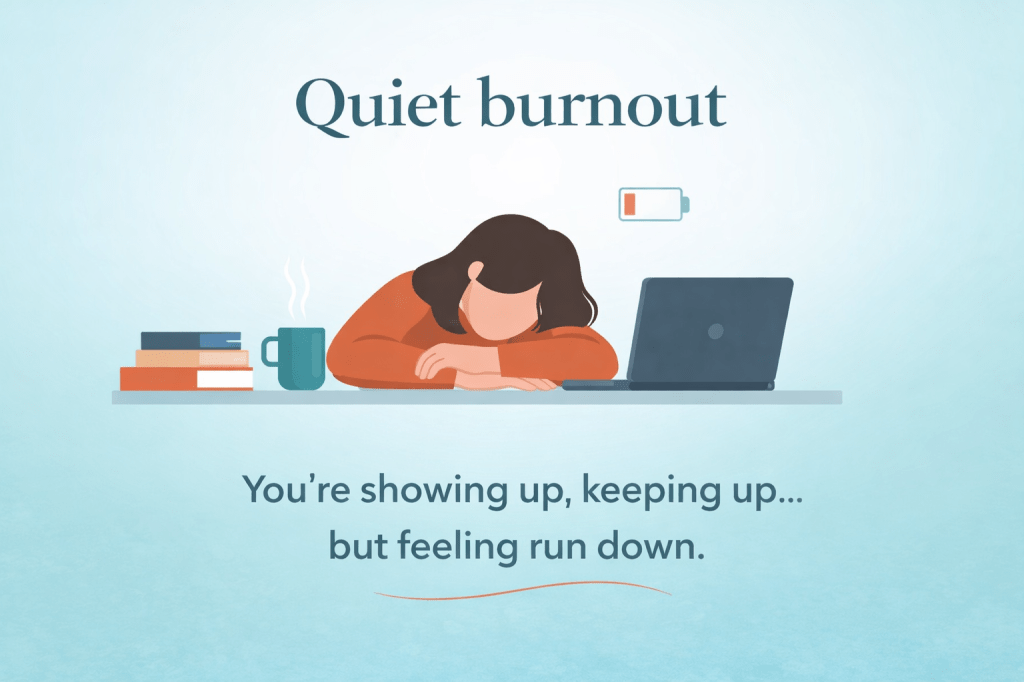
The word “burnout” is a commonly used term to describe a breaking point where someone cannot function at work anymore. However, many people are experiencing “quiet burnout,” which means they are still able to go to work, meet expectations, and perform, but they are feeling mentally drained, disconnected from their job, and depleted physically.
Quiet burnout is defined by a number of symptoms, such as:
* Persistent feelings of emotional exhaustion
* Feeling detached or numb
* Reduced creativity and motivation
* Increased irritability
* Feeling like you’re barely getting by
Because people experiencing quiet burnout are often still productive, their burnout is often overlooked by their employers, their coworkers and sometimes even themselves.
Burnout is Not a Result of Weakness
As research demonstrates, burnout is a result of chronic workplace stress, not due to individual weaknesses such as a lack of motivation or resilience.
The World Health Organization defines burnout as an occupational phenomenon that results from prolonged exposure to chronic workplace stress and includes three key characteristics:
* Emotional exhaustion
* Mental distance or cynicism toward one’s work
* Reduced professional efficacy
Additionally, burnout develops over time. The symptoms of quiet burnout reflect the early signs of burnout before a person fully disconnects from their work and collapses.
Why Quiet Burnout is So Prevalent Today
There are several factors in today’s workplace culture that contribute to quiet burnout:
1. Chronic Stress Without Recovery Time
High levels of stress combined with little time for recovery places the body in a state of hyperarousal. Research has shown that without breaks or time to disconnect, stress builds instead of dissipates (Sonnentag & Fritz, 2015).
2. Constant Availability Due to Technology
Technology has blurred the lines between work and personal life. Employees expect immediate responses, are expected to multi-task constantly, and are always available to be contacted by their employer. All of these expectations are strongly correlated with emotional exhaustion (APA, 2023).
3. High Performance Expectations
Employees who are highly capable, motivated, and responsible are most likely to develop quiet burnout. These employees will continue to complete tasks even if they are burned out because they do not want to disappoint others and do not believe they have the right to take time off to recharge (Maslach & Leiter, 2016).
4. Acceptance of Overwork as Normal
In many companies, working extended hours and being exhausted is viewed as normal. As a result, employees who are burning out often view their exhaustion as simply a normal side effect of doing their job (Maslach & Leiter, 2016).
Consequences of Quiet Burnout
Even though quiet burnout may seem like a minor problem in the short run, research has consistently shown that burnout leads to serious negative effects in the long run. Some of these effects include:
* Increased chance of developing anxiety and/or depression
* Lower job satisfaction and employee engagement
* More employees intend to quit their jobs
* Decreased cognitive abilities (attention, memory, decision making)
* Increased number of physical health problems
(Maslach & Leiter, 2016; APA, 2023)
Organizations lose money as well. According to Gallup, organizations lose billions of dollars each year in lost productivity and turnover as a direct result of burnout and disengagement (Gallup, 2023).
Self-Care Cannot Solve Burnout
Individual coping mechanisms can help alleviate some symptoms of burnout; however, burnout cannot be solved by self-care alone. The nature of the work environment and the policies and practices of the organization also play a large role in the development of burnout and the ability to recover from burnout.
According to research, interventions that focus solely on increasing individual resilience are significantly less effective than those that focus on addressing the organizational environment (Montano et al., 2014).
Quiet burnout is not a call to try harder.
Quiet burnout is a signal that there are systemic issues that need to be addressed.
Helping Employees Recover from Quiet Burnout
There are evidence-based ways to reduce burnout, including:
* Reasonable workload and pacing
* Clear priorities and role expectations
* Autonomy and flexibility in completing work
* Supportive leadership
* Protected time for relaxation and recovery
When employees have the opportunity to work under these conditions, they are more likely to recover their energy, motivation, and a sense of purpose (Bakker & Demerouti, 2017).
Recognizing the Signs Before It Becomes Too Late
Quiet burnout is usually a signal, not a failure point. Recognizing the signs of quiet burnout provides opportunities for both individuals and organizations to intervene and prevent greater damage.
To address quiet burnout, we need to be willing to look beyond how individuals cope with their jobs and evaluate how the jobs were created.
References
American Psychological Association. (2023). Work in America Survey.
https://www.apa.org/pubs/reports/work-in-america
Bakker, A.B. & Demerouti, E. (2017). Job demands-resources theory: Taking Stock and Looking Forward. Journal of Occupational Health Psychology, Vol 22, No. 3, pp 273-285.
https://dx.doi.org/10.1037%2Focp0000056
Gallup. (2023). State of the Global Workplace Report.
https://www.gallup.com/workplace/349484/state-of-the-global-workplace.aspx
Maslach, C. & Leiter, M.P. (2016). Burnout. In: The Wiley Encyclopedia of Stress and Health.
https://onlinelibrary.wiley.com/doi/10.1002/9780470015902.a0003980.pub2
Montano, D., Hoven, H. & Siegrist, J. (2014). Effects of organizational level interventions at work on employees’ health. BMC Public Health, Vol 14, p. 135.
https://bmcpubhealth.biomedcentral.com/articles/10.1186/1471-2458-14-135
Sonnentag, S. & Fritz, C. (2015). Recovery from Job Stress: The Stressor-Detachment Model. Journal of Organizational Behavior, Vol. 36, Issue S1, pp. S72-S103.
https://doi.org/10.1002/job.1924
World Health Organization. (2019). Burn-Out An Occupational Phenomenon.
https://www.who.int/news-room/questions-and-answers/item/burn-out-an-occupational-phenomenon
 Kokoro Balance Integrative Services
Leave a comment