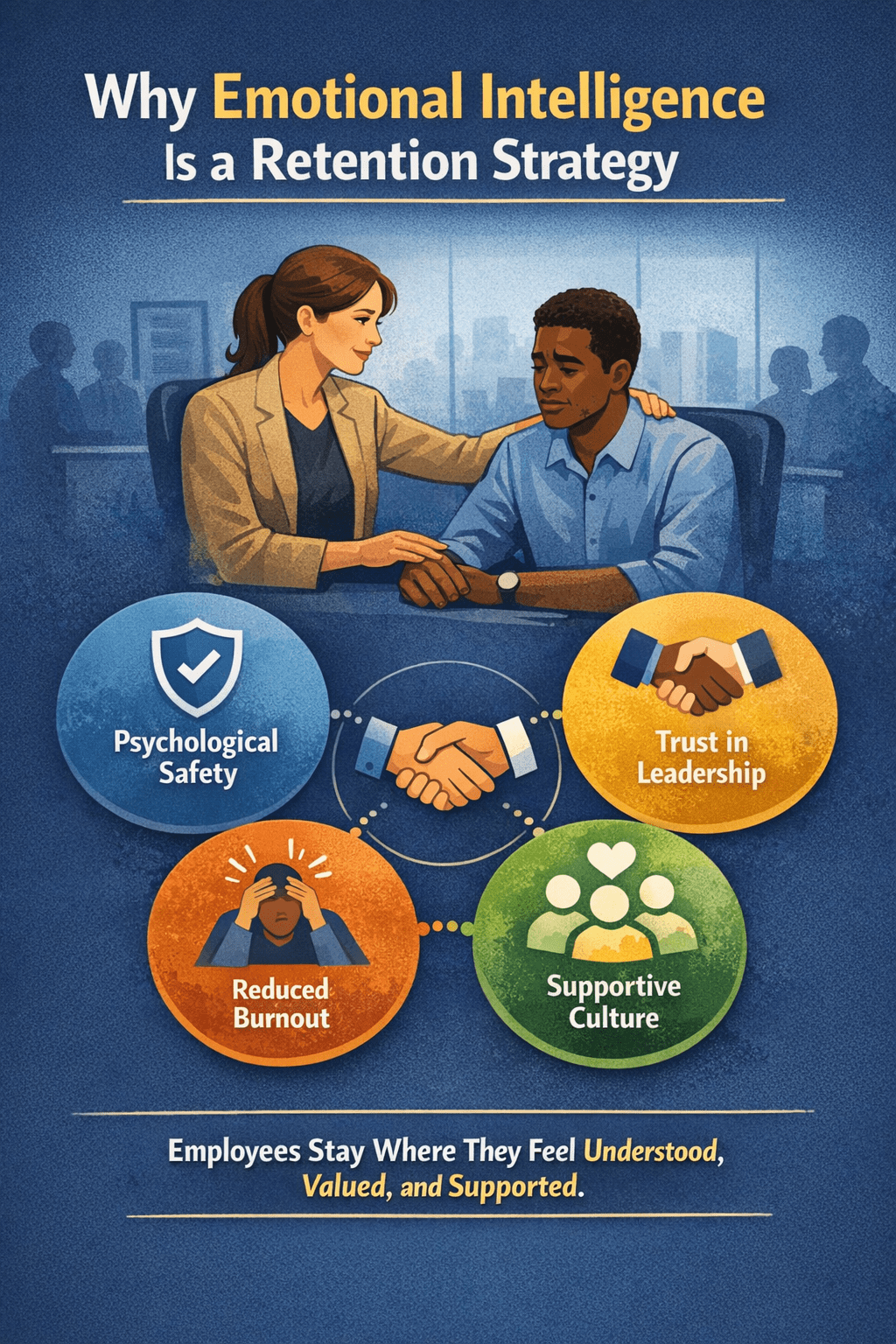
Although many organizations focus on keeping their employees with pay, benefits, and opportunities for advancement, much research has shown that it is the managers and work environment, not the job itself, that employees leave.
Emotional intelligence (EI) is sometimes referred to as a “soft” skill. However, EI is a structural competency in a leader’s skills set which is very clearly connected to an individual’s engagement, trust, and retention.
If there is no emotional intelligence present in a manager, then there will be an increase in employee turnover. If there is emotional intelligence present, employees are more likely to want to stay.
What Does Emotional Intelligence Really Mean?
Emotional intelligence is the ability to perceive and understand emotions, and to regulate those emotions so you can effectively respond to your own emotions and the emotions of others (Mayer, Salovey & Caruso, 2004).
Daniel Goleman’s framework of EI includes five competencies:
- Self-awareness
- Self-regulation
- Motivation
- Empathy
- Social skill
(Goleman, 1998)
Each of these areas are significant in the way in which a manager handles conflict, communicates during times of change, gives feedback, and responds to stress within the workplace.
Being emotionally intelligent is not about always agreeing with someone, or always being easy going; it is about being attuned to what is happening around you and being able to manage your response.
How is Emotional Intelligence Connected to Employee Retention?
1. Employee Perceived Psychological Safety
An employee is more likely to want to stay in an organization if he feels psychologically safe, i.e. he feels he is safe enough to express his thoughts, ask questions, admit to making a mistake, etc. Amy Edmondson researched psychological safety and found that it was a major factor in the performance and engagement of teams (Edmondson, 2018).
A manager who is more emotionally intelligent is going to have less difficulty:
- Responding to criticism in a non-confrontational manner
- Listening to difficult feedback
- Creating a space for debate
All of these behaviors create a sense of psychological safety and is a strong indicator of employee retention.
2. Trust in Managers
Trust in managers is one of the most powerful indicators of employee commitment. Mayer, Davis, and Schoorman created an integrated model of organizational trust and defined ability, benevolence, and integrity as the three primary aspects of trustworthiness (Mayer et al., 1995).
Emotionally intelligent managers provide clear and consistent communication during times of uncertainty. Research indicates that when employees believe that their manager is emotionally aware and empathetic, they are more trusting of the manager and less likely to want to quit (Carmeli, 2003).
3. Reduced Burnout
Emotionally intelligent managers are better at recognizing signs of burnout in their employees before they become overwhelmed with their workload, disengage, and/or experience high levels of stress. The Job Demands–Resources Model illustrates that when job demands outweigh available resources (which include social support), an employee is at a higher risk of burnout (Bakker & Demerouti, 2017).
Managers who exhibit empathy and emotional regulation contribute to an environment that mitigates stress instead of exacerbating it. Burnout is considered one of the strongest predictors of voluntary employee turnover (Maslach & Leiter, 2016). As such, emotional intelligence is essentially a preventative strategy against burnout.
How Does Emotional Intelligence Behave Under Stress?
Change (restructuring, lay-offs, rapid expansion) tests a manager’s capacity. Employees are especially sensitive to emotional cues during stressful events.
As research has shown, uncertainty increases both cognitive load and emotional burden (De Witte, 1999). When managers indicate uncertainty, but remain composed, anxiety decreases across teams.
Emotional intelligence does not mean knowing everything. Emotional intelligence means:
- Identifying what is known and what is not known
- Validating an employee’s emotional response without escalating it
- Exhibiting composure under pressure
How employees feel during periods of turmoil affects long-term commitment.
Emotional Intelligence and Emotional Labor
Emotional intelligence should not be confused with emotional labor. Emotional labor involves suppressing or managing emotions to meet organizational expectations, at a personal expense (Hochschild, 1983).
Emotional intelligence is about accurately perceiving and understanding emotions and reacting appropriately. Emotional labor is about faking it until you make it. Managers who confuse emotional intelligence with constantly appearing positive or avoiding conflicts may inadvertently damage the trust of their employees.
Retention is not dependent upon a manager’s showmanship; retention is dependent upon a manager’s self-control, transparency and predictability.
Retention is Relational
Employees are more likely to remain in organizations where they feel:
- Valued
- Respected
- Free to contribute
- Supported when experiencing stress
Compensation may draw new talent into an organization. Emotional intelligence retains that talent. Organizations that invest time in developing their manager’s emotional intelligence, primarily at the manager level, are not investing in softness. Organizations are investing in sustained engagement, trust, and stability.
Relational leadership is not discretionary in today’s competitive labor market. Relational leadership is strategic.
References
Bakker, A. B., & Demerouti, E. (2017). Job demands–resources theory: Taking stock and looking forward. Journal of Occupational Health Psychology, 22(3), 273–285.
https://doi.org/10.1037/ocp0000056
Carmeli, A. (2003). The relationship between emotional intelligence and work attitudes, behavior and outcomes. Journal of Managerial Psychology, 18(8), 788–813.
https://doi.org/10.1108/02683940310511881
De Witte, H. (1999). Job insecurity and psychological well-being. European Journal of Work and Organizational Psychology, 8(2), 155–177.
https://doi.org/10.1080/135943299398302
Edmondson, A. C. (2018). The fearless organization. Wiley.
Goleman, D. (1998). Working with emotional intelligence. Bantam Books.
Hochschild, A. R. (1983). The managed heart: Commercialization of human feeling. University of California Press.
Maslach, C., & Leiter, M. P. (2016). Burnout. Wiley.
Mayer, R. C., Davis, J. H., & Schoorman, F. D. (1995). An integrative model of organizational trust. Academy of Management Review, 20(3), 709–734.
https://doi.org/10.5465/amr.1995.9508080335
Mayer, J. D., Salovey, P., & Caruso, D. R. (2004). Emotional intelligence: Theory, findings, and implications. Psychological Inquiry, 15(3), 197–215.
https://doi.org/10.1207/s15327965pli1503_02
 Kokoro Balance Integrative Services
Leave a comment