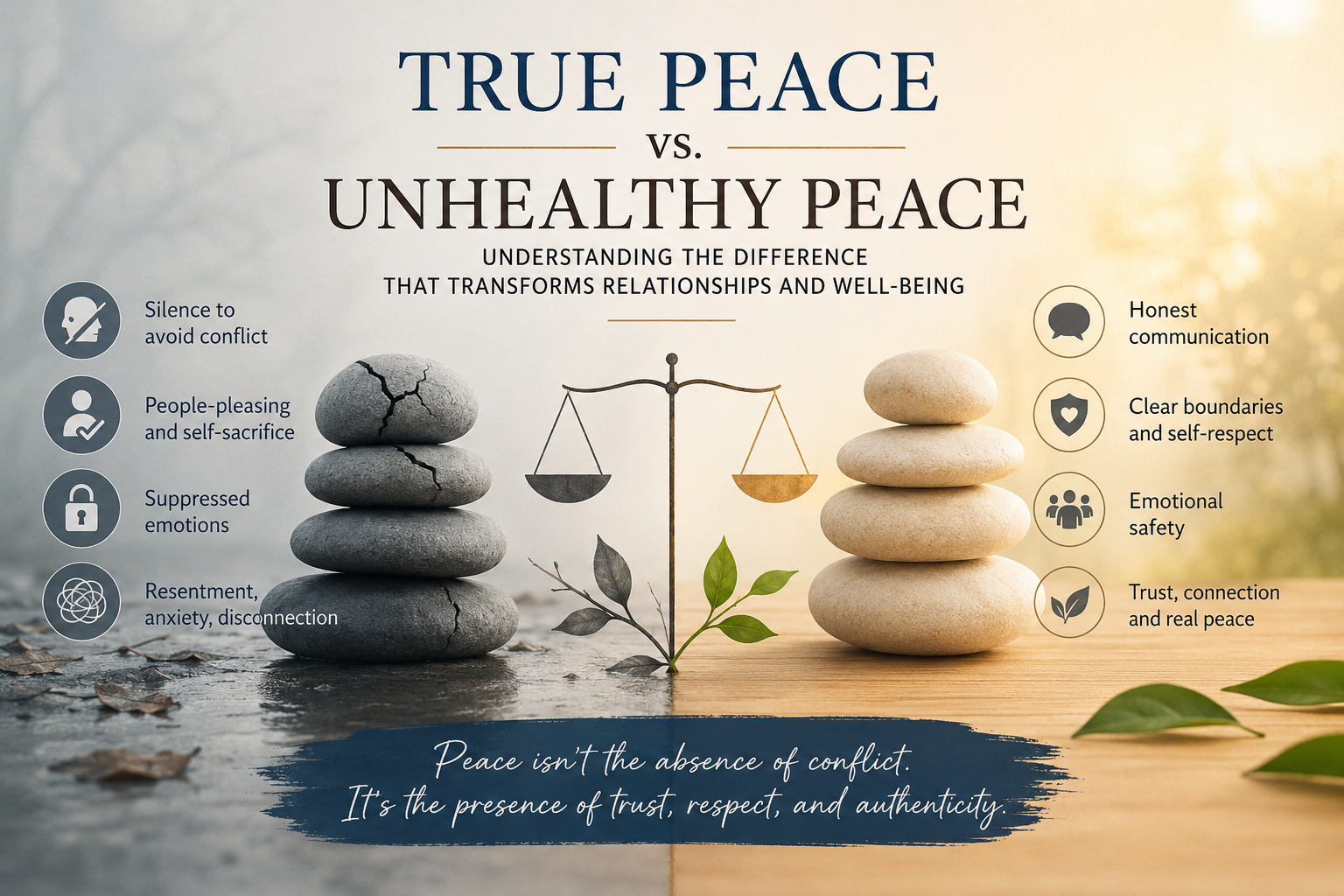
Most people want peace. We want peaceful families, peaceful workplaces, and a peaceful life. And we see peace as a sign of emotional maturity, good communication, and personal development. But not all peace is good peace. Sometimes what seems like peace isn’t really peace. Sometimes it’s just avoidance, denial, or sacrifice. Just because there aren’t fights doesn’t mean everything is well. Many People will pretend to have peace by never saying no to anyone else, suppressing their feelings to keep everyone happy, and putting everyone else before themselves. This is what i call Unhealthy Peace.
What is Unhealthy Peace?
Unhealthy Peace happens when a group has peace because nobody talks about anything serious. Instead of using good communication and showing each other respect, they use silence, submission, or abandonment of their own interests. Examples include:
– being unwilling to talk about big issues.
– always saying yes when you really want to say no.
– suppressing your true feelings so there won’t be conflict.
– constantly adjusting your plans to fit someone else’s schedule.
– allowing someone to break the rules of your relationship without telling them no.
– Staying silent so someone else doesn’t get upset.
Although Staying silent and letting things slide may make some People happy right now and may lower stress, it will generally cause you emotional pain later. Even though the relationship may seem fine and the two People involved in it may both think that everything is okay, One person may feel resentful toward the other, tired of always giving in, frustrated by lack of open communication, disconnected from the other person and feeling unheard.
Why do some People make Unhealthy Peace their goal?
Many People don’t choose Unhealthy Peace. It is usually something that was taught as a survival mechanism. For example, when children grow up in homes where arguing is very painful or unstable; or when kids learn early on that saying what they want causes anger, disappointment or criticism then they will continue to teach their younger selves that keeping the peace is safer than taking risks. As time goes on, choosing to fight less can start to become easier than dealing with fighting. However, the cost of this decision is often emotional well-being.
How does avoiding conflict hurt you?
Even though Unhealthy Peace may help you avoid some short term discomfort, in the long run it can cause many problems. For instance:
– resentment builds up
When you continually deny yourself and allow others to take advantage of you; your frustrations will turn into resentment. Patience eventually turns to resentment.
– authenticity Decreases
Relationships are built on real connections. When you spend your entire relationship hiding your thoughts, feelings and desires; you lose who you truly are as a person and become less emotionally present.
– boundaries are ignored
Setting boundaries clearly communicates that you value yourself. If you don’t set boundaries; you can easily be seen as weak, abused or drained emotionally.
– anxiety Increases
Avoidance will give you temporary relief however in most cases it Increases anxiety overtime. The longer you avoid having difficult conversations, the harder they will be to have.
Real peace works differently
Real peace is not about having no conflicts. Real peace is having a relationship where everyone feels safe enough to express their opinions openly – even when those conversations are uncomfortable. It involves:
– respectfully disagreeing
– setting Clear boundaries
– communicating clearly
– being accountable together
– feeling emotionally secure
– being yourself.
You cannot have a perfect relationship that never argues. What matters is that arguments can be expressed in a manner which will lead to a better understanding of each other.
Unhealthy Peace in workplaces
Just like in our personal relationships; unhealthy peace also develops in many workplaces when employees are too afraid to tell management or coworkers about problems. When employees stay quiet due to fear of confrontation; businesses suffer from:
– reduced creativity
– increased employee disengagement
– ongoing unresolved disputes
– poor communication
– lower levels of psychological safety.
And although employees may agree with management on paper; this may be out of fear of losing their jobs rather than agreeing to something they believe in.
From peacekeeping to peacebuilding
There is a key distinction between being a peacemaker and being a peace builder. A peacemaker typically seeks ways to eliminate conflict.
A peace builder seeks ways to establish the climate for open communication and healthy resolutions.
A peacemaker wants to know “how do i stop this conflict?”
A peace builder wants to know “what can i do today that will help us resolve this issue in a positive way?”
One keeps the conflict from happening. The other creates growth from resolving the conflict.
Questions to ask yourself
If you notice you’re willing to compromise in order to avoid conflict; ask yourself:
Is there something unhealthy going on here or am i just scared to discuss this?
Are there things i’m not communicating?
What would happen if i spoke my truth?
Am i trying to protect this relationship or am i trying to protect myself from conflict?
What would open, honest communication look like in this case?
Final thoughts
Peace is not achieved through complete silence, complete avoidance of conflict, or total sacrifice. True peace offers space for authenticity, boundaries, accountability and open communication. True peace understands that uncomfortable discussions can be a catalyst for growth and that hard conversations can strengthen Relationships instead of destroy them.
Regardless of whether you’re focusing on your personal Relationships, your Workplace or your role as leader; true lasting peace comes not from avoiding conflict but from learning to successfully deal with it with confidence, with clarity and with compassion.
References
American Psychological Association. (2023). Conflict resolution and communication in relationships.
Edmondson, A. C. (2018). The fearless organization: Creating psychological safety in the workplace for learning, innovation, and growth. Wiley.
Gottman, J. M., & Silver, N. (2015). The seven principles for making marriage work. Harmony Books.
Linehan, M. M. (2015). DBT skills training manual (2nd ed.). Guilford Press.